
If your video doorbell is laggy, your back-yard camera drops off twice a day, or your smart lock refuses to lock when you ask Siri from the kitchen: your network is the problem, not the gear.
Why range extenders fail
A range extender repeats your WiFi on the same frequency it received it. Real-world result: half your bandwidth, a separate SSID your phone has to manually switch to, and devices that cling to the weakest signal because they don't know any better.
What mesh actually does
A mesh creates one WiFi network across multiple access points, all sharing the same SSID. Your phone roams between them seamlessly: same name, same password, no manual switching. Smart devices stay connected to whichever node is closest.
Wired backbone is the secret
The best meshes connect their nodes by Ethernet (or PoE), not WiFi. That removes the bandwidth penalty entirely. We pull a Cat6 between nodes wherever the property allows it.
Our usual stack for connected homes
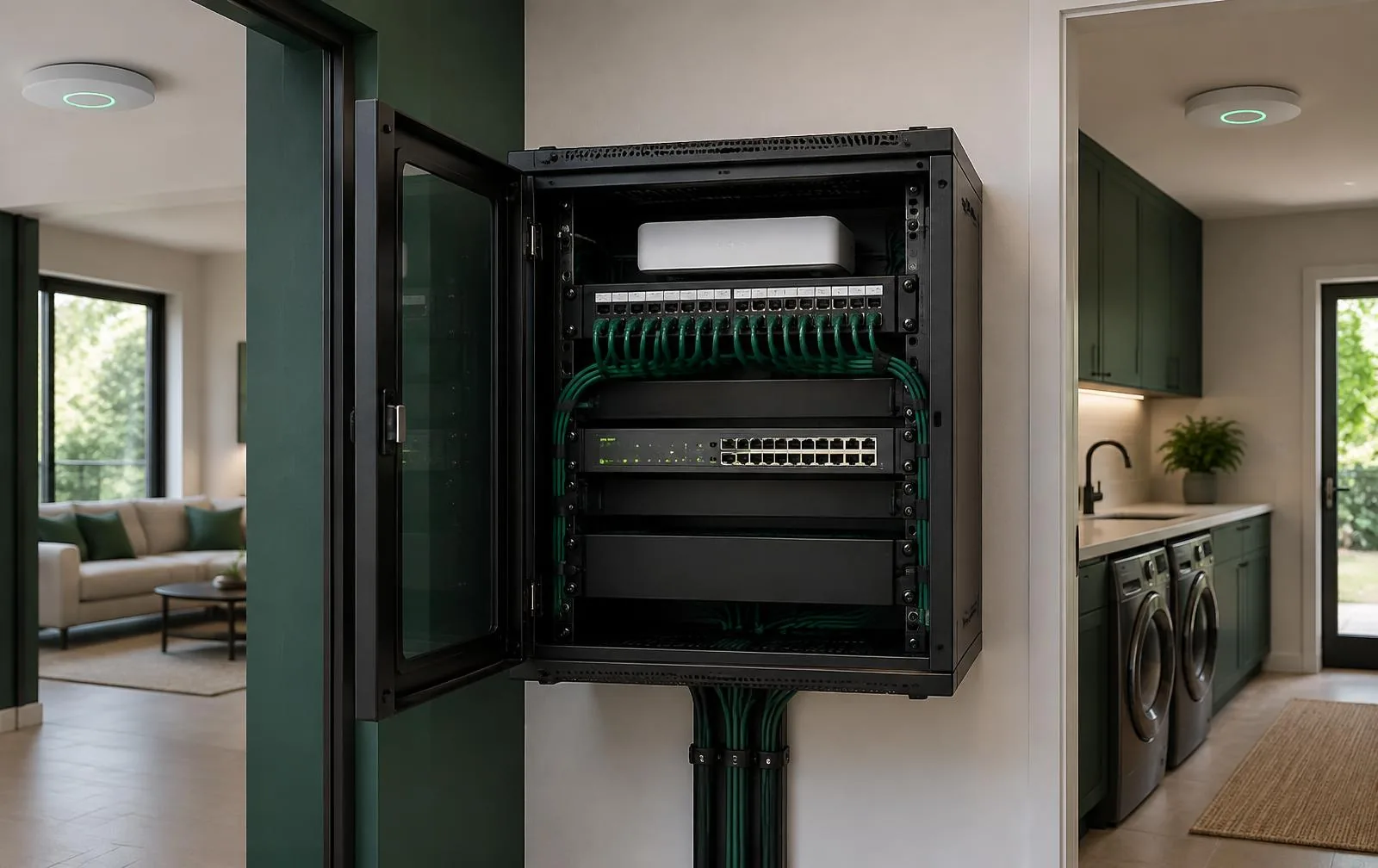
Two or three Ubiquiti UniFi or TP-Link Deco access points, a small PoE switch, a separate VLAN for IoT/CCTV so smart gear can't see your work laptop, and a guest network for visitors. Every camera and access point runs over PoE: no plug-packs hanging in the roof.
What it'll cost
A two-node mesh fitted with the right cabling typically lands around $900–$1,500 in a Melbourne home. Three-node UniFi homes with a controller and PoE switch are usually $2,000–$3,500. Either way, it's the smartest spend on your smart home.